#include<iostream>
using namespace std;
int main()
{
int i;
for (i = 0; i < 10; i++)
{
cout << "Hello" << "\n";
cout << "There" << "\n";
}
return 0;
}
Output:
C++ is the language Cfree is the compiler.. You are the Program User. I am the Programmar. ~Osaid Jamal
Wednesday, 16 April 2014
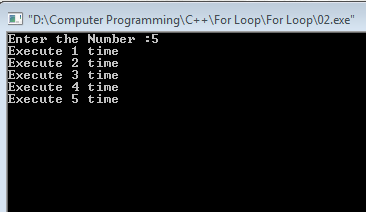
For Loop- Counter Program- Using C++
#include<iostream>
#include<conio.h>
using namespace std;
int main()
{
// Variable Declaration
int a;
// Get Input Value
cout<<"Enter the Number :";
cin>>a;
//for Loop Block
for (int counter = 1; counter <= a; counter++)
{
cout<<"Execute "<<counter<<" time"<<endl;
}
// Wait For Output Screen
getch();
return 0;
}
Output:
#include<conio.h>
using namespace std;
int main()
{
// Variable Declaration
int a;
// Get Input Value
cout<<"Enter the Number :";
cin>>a;
//for Loop Block
for (int counter = 1; counter <= a; counter++)
{
cout<<"Execute "<<counter<<" time"<<endl;
}
// Wait For Output Screen
getch();
return 0;
}
Output:
Factorial Using C++
#include<iostream>
using namespace std;
int main()
{
int num,factorial=1;
cout<<" Enter Number To Find Its Factorial: ";
cin>>num;
for(int a=1;a<=num;a++)
{
factorial=factorial*a;
}
cout<<"Factorial of Given Number is ="<<factorial<<endl;
return 0;
}
Output:
using namespace std;
int main()
{
int num,factorial=1;
cout<<" Enter Number To Find Its Factorial: ";
cin>>num;
for(int a=1;a<=num;a++)
{
factorial=factorial*a;
}
cout<<"Factorial of Given Number is ="<<factorial<<endl;
return 0;
}
Output:
Tuesday, 15 April 2014
Representation of a Linked List In a Memory
#include<iostream>
using namespace std;
struct node
{
int data;
node *link;
};
node *head;
main()
{ head= new node;
head->data=405;
head->link=NULL;
cout<<"The Value in the starting node= "<<head->data<<endl;}
Output:
using namespace std;
struct node
{
int data;
node *link;
};
node *head;
main()
{ head= new node;
head->data=405;
head->link=NULL;
cout<<"The Value in the starting node= "<<head->data<<endl;}
Output:
Saturday, 12 April 2014
Array Using C++
Array: An array is a variable that holds multiple values of the same type.
Arrays and pointers have a special relationship as arrays use pointers to reference memory locations. Syntax is :
#include <iostream.h>
#include <iomanip.h> //we use this header file for set w OR Width
main()
{
int arr[ 10 ]; // its an integer type array of size 10
/*initialize elements of (array) i.e start with 0 and n-1 means 0to9
for sum using for loop*/
for ( int i = 0; i < 10; i++ )
{
arr[ i ] = i + 100;
// i.e calculation 100 =0 + 100 to 109= 9+100
}
cout << "Array Members" << setw( 12 ) << "Values" << endl;
// again for loop for output/ display
for ( int j = 0; j < 10; j++ )
{
cout << setw( 6 )<< j << setw( 17 ) << arr[ j ] << endl;
}
return 0;
}
Output:
Arrays and pointers have a special relationship as arrays use pointers to reference memory locations. Syntax is :
datatype arrayname[array size];
#include <iostream.h>
#include <iomanip.h> //we use this header file for set w OR Width
main()
{
int arr[ 10 ]; // its an integer type array of size 10
/*initialize elements of (array) i.e start with 0 and n-1 means 0to9
for sum using for loop*/
for ( int i = 0; i < 10; i++ )
{
arr[ i ] = i + 100;
// i.e calculation 100 =0 + 100 to 109= 9+100
}
cout << "Array Members" << setw( 12 ) << "Values" << endl;
// again for loop for output/ display
for ( int j = 0; j < 10; j++ )
{
cout << setw( 6 )<< j << setw( 17 ) << arr[ j ] << endl;
}
return 0;
}
Output:
Pointers Using C++ Program 1
//Pointers: A pointer is a variable that contains the address of a variable.
#include<iostream>
using namespace std;
main()
{
int x=100; // initialize integer type variable name x
int *y; // declare integer type pointer y
cout<<x; // print value of integer type variable x
cout<<"\n"; // new line
y=&x; // giving address of variable x to y
*y=5000; // without accessing x changing value of x=100 to 5000
cout<<x; // after, poiting now, value of x is : 5000
cout<<"\n"; // new line
int **z; // declare integer type pointer to pointer c
z=&y; // giving address of y to z
**z=90; // now, without disturbing x&y value of x is 90
cout<<x; //value of x is 90
}
Output:
#include<iostream>
using namespace std;
main()
{
int x=100; // initialize integer type variable name x
int *y; // declare integer type pointer y
cout<<x; // print value of integer type variable x
cout<<"\n"; // new line
y=&x; // giving address of variable x to y
*y=5000; // without accessing x changing value of x=100 to 5000
cout<<x; // after, poiting now, value of x is : 5000
cout<<"\n"; // new line
int **z; // declare integer type pointer to pointer c
z=&y; // giving address of y to z
**z=90; // now, without disturbing x&y value of x is 90
cout<<x; //value of x is 90
}
Output:
Nested For Loop Using C++ Program(2)
#include<iostream>
using namespace std;
main()
{
for(int i=1;i<5;i++)
{
cout<<i<<"\t";
for(int j=1;j<5;j++)
cout<<j;
cout<<"\n";
}
}
// پہلا لوپ ایک بار چلے گا تو دوسرا والا لوپ 4 بار چلے گا اور پھر پہلا والا لوپ دوسری بار چلے گا تو دوسرا
//لوپ 4 بار چلے گا پھر اسی طرح چار بار پہلا لوپ چلے گا
OutPut:
using namespace std;
main()
{
for(int i=1;i<5;i++)
{
cout<<i<<"\t";
for(int j=1;j<5;j++)
cout<<j;
cout<<"\n";
}
}
// پہلا لوپ ایک بار چلے گا تو دوسرا والا لوپ 4 بار چلے گا اور پھر پہلا والا لوپ دوسری بار چلے گا تو دوسرا
//لوپ 4 بار چلے گا پھر اسی طرح چار بار پہلا لوپ چلے گا
OutPut:
Subscribe to:
Posts (Atom)